A failing transmission usually gives warnings before it quits completely. The hard part is knowing which signs mean schedule service soon and which signs mean stop driving before the damage spreads. Here are the symptoms Arlington Heights drivers should take seriously.
1. The Engine Revs But The Vehicle Does Not Pull Normally
This is what most drivers call slipping. RPM rises, but speed does not match it. It can happen during acceleration, on a shift, or when the vehicle is hot. Low fluid, pressure loss, worn clutches, converter problems, or CVT belt and pulley wear can all create this feeling. Continued driving can turn a limited issue into a rebuild.
2. Delayed Engagement Into Drive Or Reverse
If you shift from Park and the vehicle pauses before moving, the transmission is telling you pressure is slow to build or a clutch circuit is not applying correctly. A slight delay that happens once in deep cold is different from a regular delay every morning. Track whether it happens cold, hot, in Drive, in Reverse, or both.
3. Harsh Shifts Or A Bang Into Gear
A hard shift can come from a control issue, valve-body wear, adaptation problems, mount movement, or internal wear. The key is whether it happens on one specific shift, after warmup, under load, or randomly. Harsh engagement should not be ignored because shock through the drivetrain can damage other parts.
4. Shudder At Light Throttle
Many drivers describe shudder as driving over rumble strips. It may be torque-converter clutch behavior, CVT trouble, fluid breakdown, engine misfire, or driveline vibration. We do not call it a transmission failure until the road test and scan data support that conclusion.
5. Leaks Under The Vehicle
Red, amber, or dark fluid under the vehicle can point to a pan gasket, axle seal, cooler line, case seal, or transfer-case issue. Around the northwest suburbs, winter salt can be hard on cooler lines and fittings. A small leak can become a pressure problem if the fluid level drops far enough.
6. Burnt Smell Or Dark Fluid
Burnt fluid means heat. Heat can come from old fluid, low fluid, converter slip, cooler restriction, towing, heavy traffic, or internal clutch wear. A fluid change may help if the unit is not damaged. If the pan has debris or the vehicle already slips, fresh fluid alone is not the repair.
7. Warning Lights Or Transmission Codes
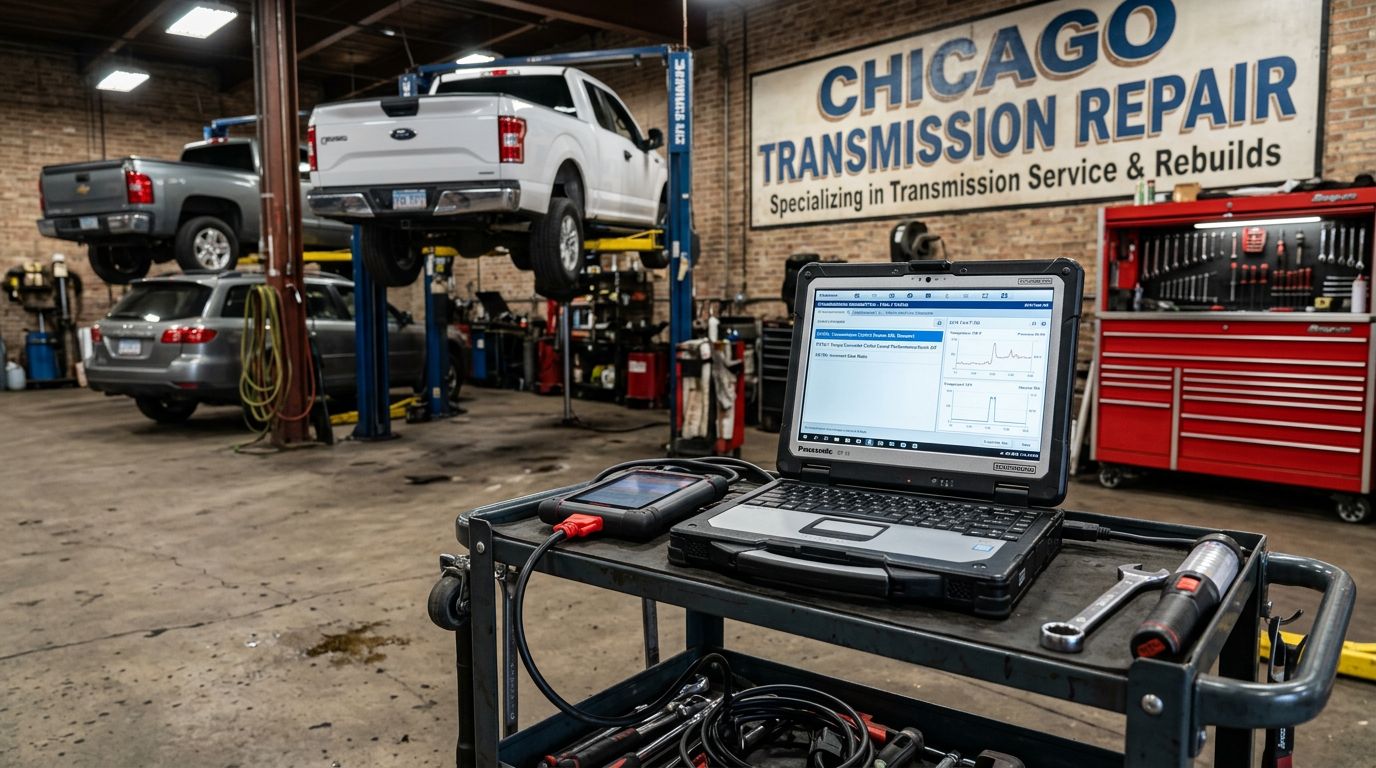
A check-engine light can store transmission-related codes even when the dash does not say "transmission." Codes for ratio errors, pressure, solenoids, temperature, converter clutch, or speed sensors are useful starting points. They do not replace inspection, but they keep the diagnosis from being a guess.
When To Tow Instead Of Drive
Consider towing if the vehicle barely moves, slips badly, smells burnt, leaks heavily, overheats, or bangs into gear. If it drives normally but has a warning light or mild symptom, call first and describe it. A short drive may be fine; a highway run may not be.
What We Need On The First Call
Have the year, make, model, mileage, symptom, when it happens, fluid condition if known, and any codes or prior estimate. Mention whether you commute on Route 53 or I-90, tow, drive short winter trips, or noticed the problem after a fluid service. The more specific the symptom history, the faster we can separate maintenance, targeted repair, rebuild, or replacement.
Get The Warning Checked
Call or text 847-393-0191 before the symptom gets worse. We will help you decide whether to drive in, tow in, or bring a prior estimate for a second opinion.
Have a Transmission Problem?
Get a free computer diagnostic from Arlington Heights transmission repair support.